


You have forty browser tabs open, each one a vacation rental that looked perfect in the thumbnail and disappointing by the third photo. Somewhere around tab thirty, you start wondering if there is a faster way to do this. That is the exact frustration Plum Guide was built to solve: instead of scrolling through millions of self-listed homes, it shows you only the ones its own team has already inspected and approved.
The catch is the price tag. Plum Guide homes tend to cost more than the equivalent Airbnb or Vrbo listing, and “curated” is doing a lot of work in the marketing copy. So is the premium justified, or are you just paying more for the same kind of place you would have found anyway? We looked at how the vetting actually works, what real guests say about the booking experience, and where the platform earns its markup.
Browse Plum Guide’s Curated Homes
Benefits of Using Plum Guide
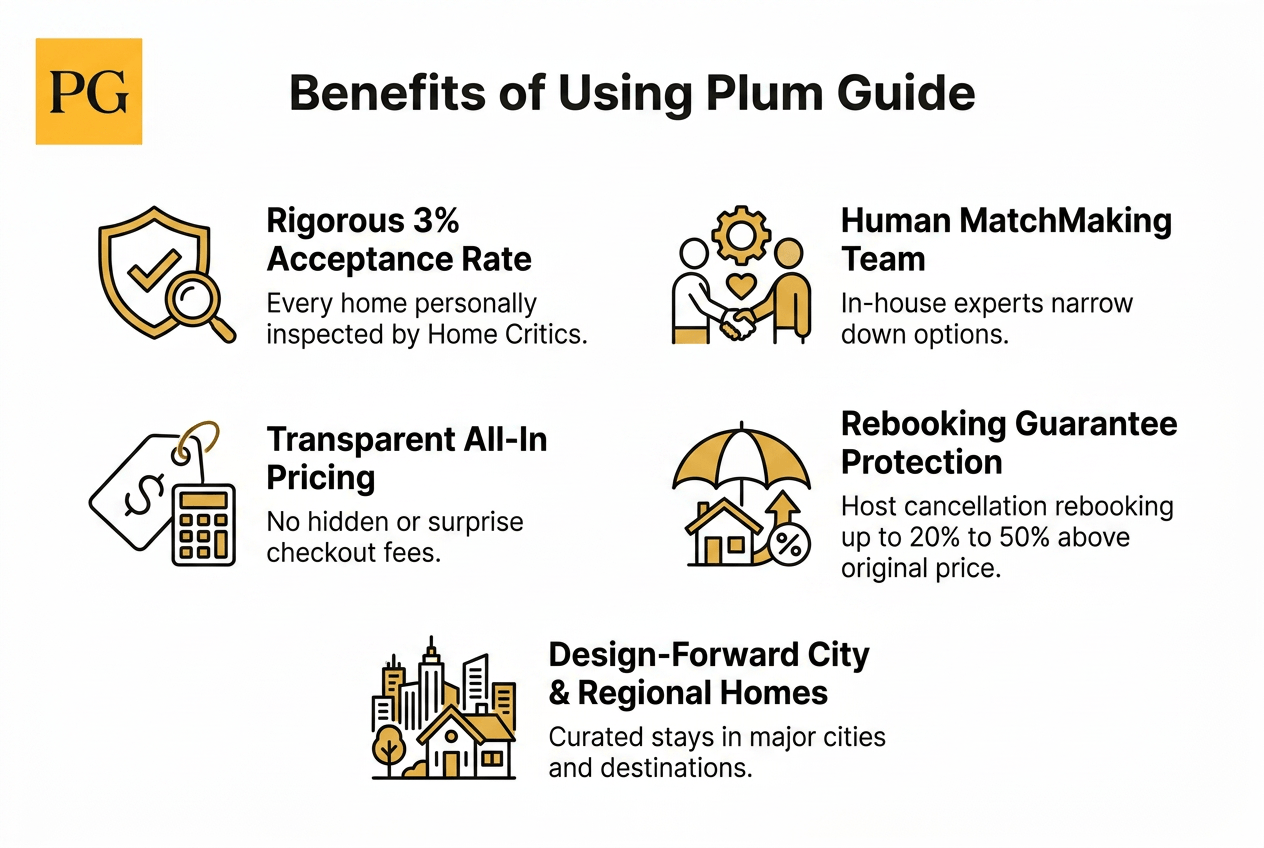
- Every listed home is personally inspected before it is accepted, only the top 3% make the cut
- A human MatchMaking team helps narrow down options instead of leaving you to filter alone
- Transparent, all-in pricing with no surprise fees added at checkout
- A rebooking guarantee if a host cancels, up to 50% above the original price close to check-in
- Design-forward homes concentrated in major cities and sought-after regions
What Plum Guide Actually Is
Plum Guide launched in London in 2016 with a simple pitch: vacation rental sites had turned into an overwhelming scroll of near-identical listings, and most travelers did not have the time or expertise to tell a genuinely great home from a merely photogenic one. Instead of hosting every property that signs up, Plum Guide built a team of local vetters, sometimes called Home Critics, who inspect properties in person against a fixed set of criteria before anything goes live.
The result is a smaller catalog, now more than 30,000 homes across over 40 destinations including London, Paris, Lisbon, Tuscany, and Los Angeles, pulled from more than 25 different booking sites and independent hosts. Plum Guide has picked up recognition from outlets like Condé Nast Traveller and Harper’s Bazaar along the way, and positions itself less as a marketplace and more as a filter sitting on top of the wider vacation rental market.
What Plum Guide Offers
The Vetting Process
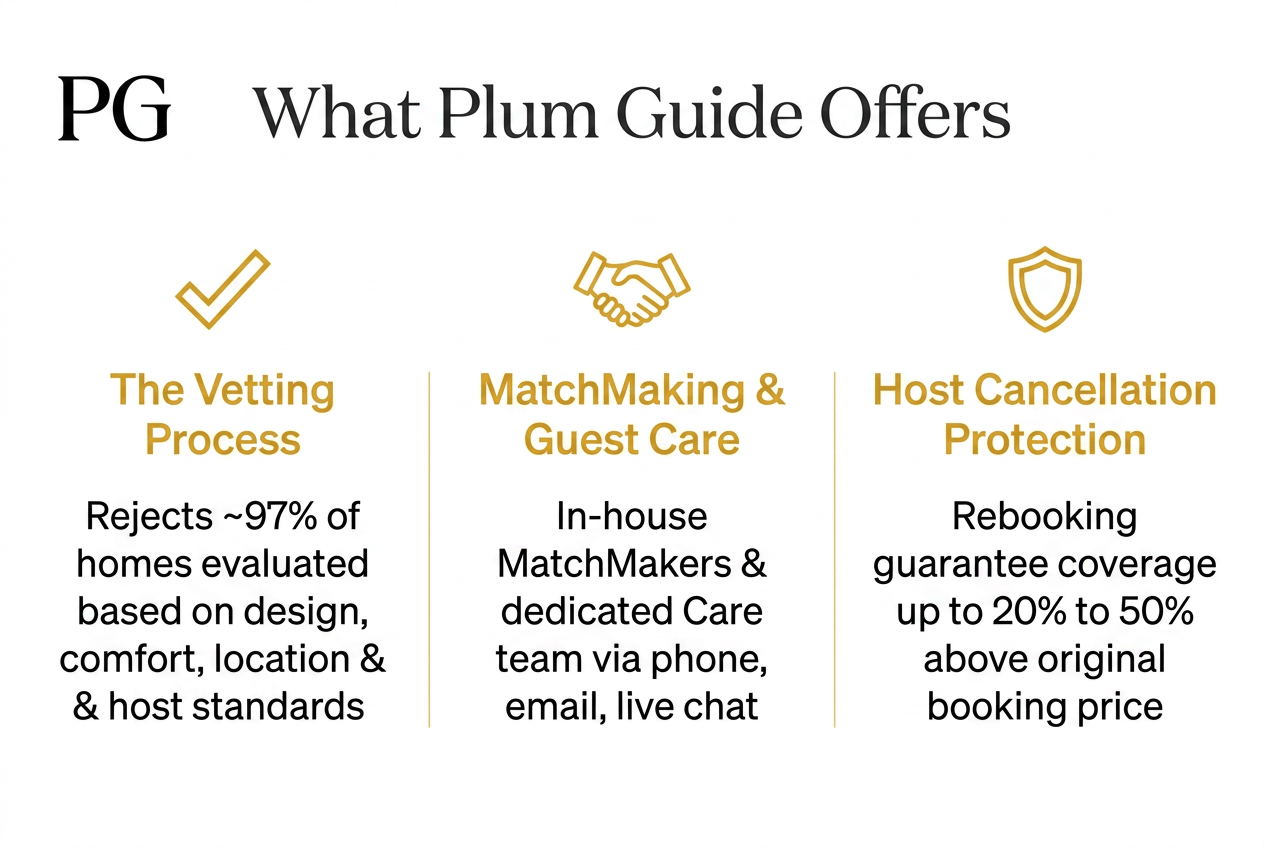
Plum Guide reports rejecting roughly 97% of homes it evaluates. Properties are judged on design, comfort, location, and host responsiveness, and the company says it has screened well over a million homes globally to build its current collection. That rejection rate is the core of the pitch: fewer options, but a much higher hit rate on quality.
MatchMaking and Guest Care
Rather than routing every question through a chatbot, Plum Guide leans on an in-house team it calls MatchMakers to help travelers narrow down homes based on their trip, and a separate Care team to handle support during the stay itself, reachable by phone, email, or live chat.
Cancellation and Host Protection
Cancellation terms are set per host and generally fall into a handful of policy tiers, from strict to flexible, disclosed clearly at booking. If a host cancels, Plum Guide’s own guarantee kicks in: the company will try to rebook the guest into a comparable home, even one worth up to 20% more than the original booking, rising to 50% if the cancellation happens within 5 days of check-in.
Is Plum Guide Reliable? The Trust Question
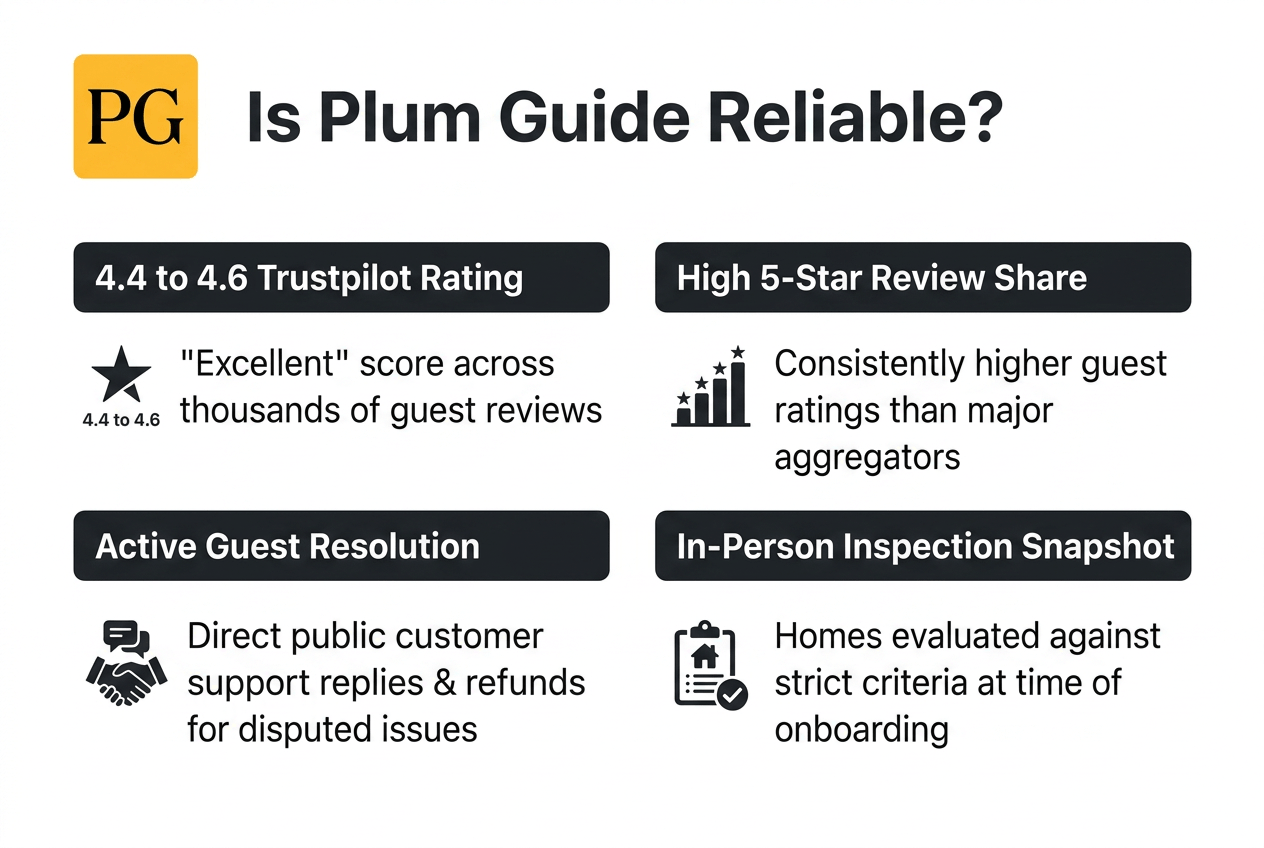
On Trustpilot, Plum Guide holds a consistently strong score, generally landing in the “Excellent” range around 4.4 to 4.6 out of 5 across several thousand reviews, with the large majority of guests leaving 5-star ratings. That is a notably better spread than the major aggregators it competes with, several of which sit well below 2 out of 5 on the same platform.
The complaints that do show up follow a familiar pattern for the vacation rental category: a host cancellation with too little notice, a property that did not fully match its listing, or a slower-than-expected refund on a disputed damage charge. Plum Guide’s public replies to negative reviews tend to lean toward siding with the guest and offering a rebooking or refund, which is not universal in this industry. Still, the vetting process is a snapshot at the time of inspection, not an ongoing guarantee, so a home’s day-to-day upkeep can drift between checks.
Compare Plum Guide Homes Before You Book
Plum Guide vs. Competitors
| Parameter | Plum Guide | Airbnb | Vrbo |
|---|---|---|---|
| Vetting | Every home personally inspected, only the top 3% of applicants accepted | Minimal vetting, mostly self-listed by hosts | Minimal vetting, mostly self-listed by hosts |
| Selection Size | Smaller, curated, over 30,000 homes across 40+ destinations | Massive, millions of listings worldwide | Large, several million listings, mostly whole homes |
| Pricing | Premium, homes typically run $300 to $700+ a night | Wide range, budget rooms to luxury villas | Wide range, generally family and villa-focused |
| Customer Support | Human MatchMaking and Care team, phone, email, and live chat | Largely self-service, AI-assisted resolution center | Largely self-service, resolution center for major issues |
| Host Cancellation Protection | Rebooking guarantee up to 20 to 50% above original price | Rebooking assistance, coverage varies by case | Limited, mostly a refund with no guaranteed rebooking |
| Best For | Design-led stays and travelers who want the search done for them | Widest possible choice and lowest price points | Larger groups wanting a full private home |
Plum Guide’s edge over Airbnb and Vrbo is not selection size, it is confidence. Airbnb and Vrbo both offer vastly more listings and generally lower prices, but that also means more variance in quality and a support experience that leans heavily on self-service. Plum Guide trades that breadth for a smaller, pre-screened catalog and a human team backing up the booking, which shows up directly in the price.
Booking Experience and Everyday Use
The booking flow itself is straightforward: search by destination, dates, and guest count, then filter by amenities like pools or pet-friendliness. Because the catalog is smaller than a typical OTA, browsing feels less like scrolling and more like shortlisting, which is the entire point of the product.
There is no dedicated mobile app as of this review, so travelers manage bookings through the mobile site, which several reviewers note works fine but lacks the convenience of a native app. Support is reachable through live chat, email, or phone rather than routing exclusively through a bot, and Plum Guide reports replying to the large majority of negative reviews directly, typically within a couple of weeks.
Start Planning Your Next Stay with Plum Guide
Plum Guide Pros and Cons
| Pros | Cons |
|---|---|
| Every home is personally vetted, cutting out the guesswork of scrolling hundreds of listings | Prices run noticeably higher than Airbnb or Vrbo for a comparable-sized home |
| Real MatchMaking and Care team available by phone, email, and live chat, not just a chatbot | Selection is smaller and concentrated in major cities and popular regions |
| Strong host-cancellation protection, including a rebooking guarantee close to check-in | Cancellation terms vary by property, so refund amounts depend on which policy tier a host uses |
| Trustpilot rating sits consistently in the 4.4 to 4.6 range across thousands of reviews | A small share of reviews describe host no-shows or listings that didn’t match photos |
| Transparent, all-in pricing with no surprise fees added at checkout | No dedicated mobile app yet, everything runs through the mobile site |
Frequently Asked Questions
Is Plum Guide worth the higher price?
For travelers who value a vetted, design-forward home and don’t want to gamble on photos, generally yes. If budget is the top priority, Airbnb or Vrbo will usually undercut Plum Guide on price for a similar-sized space.
How strict is Plum Guide’s vetting process?
Very. The company reports accepting only around the top 3% of homes it evaluates, based on in-person inspections covering design, comfort, location, and host responsiveness.
What happens if a Plum Guide host cancels my booking?
Plum Guide will attempt to rebook you into a comparable home, even one costing up to 20% more than your original booking, or up to 50% more if the cancellation happens within 5 days of check-in.
Does Plum Guide charge hidden fees?
Reviewers consistently point to transparent, all-in pricing, with the price shown at search matching the price at checkout.
Is Plum Guide available outside major cities?
Coverage is concentrated in more than 40 sought-after destinations, from London and Paris to Los Angeles and Tuscany, so it is not as broad as Airbnb’s global footprint in smaller or less-touristed areas.
Final Verdict
Plum Guide is not trying to be the biggest vacation rental platform, it is trying to be the most trustworthy one, and the 3% acceptance rate backs that positioning up. The premium over Airbnb and Vrbo is real, but so is the reduction in guesswork, and the human support team is a genuine differentiator in a category that has largely automated its way out of customer service.
If you are booking a milestone trip, a design-conscious stay, or simply do not have the patience to vet twenty listings yourself, Plum Guide’s curated approach earns its place in the search. For a quick budget booking in a less-covered destination, a broader platform will likely serve you better.